
What is the history of mathematics?
Introduction
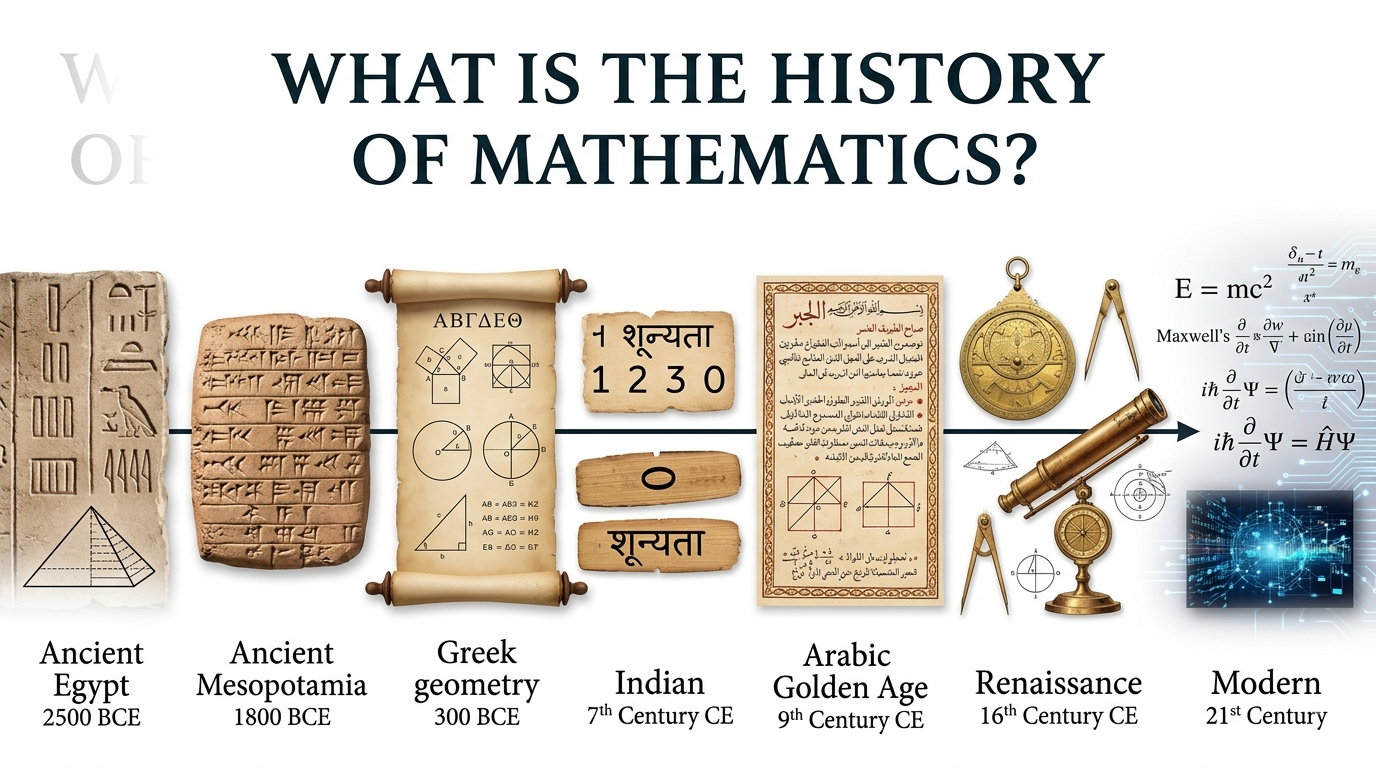
Mathematics is one of the oldest forms of human knowledge, which evolved from simple needs such as counting, measuring, comparing quantities, and recognizing patterns. As human society became more organized, mathematical concepts became essential for agriculture, trade, construction, astronomy, and administration. Civilizations as diverse as Mesopotamia, Egypt, India, China, and Greece contributed to its development. Later, scholars in the Islamic world preserved and expanded earlier knowledge, while European mathematicians developed new ideas during the Enlightenment and the Scientific Revolution. Concepts such as zero, algebra, geometry, calculus, probability, and statistics gradually transformed mathematics into a broad and sophisticated field of knowledge. Today, mathematics is fundamental to science, technology, engineering, computing, medicine, economics, and space exploration. Understanding its history shows how mathematical knowledge has evolved along with human civilization.
What Is Mathematics?
Mathematics is the systematic study of quantity, number, patterns, structure, shape, relationships, change, and logical thinking. In simple terms, mathematics helps us answer questions like ‘how many objects are there’, ‘how big or small an object is’, ‘how far apart are two objects’, ‘how fast something is changing’, and ‘what patterns exist’.
Mathematics is much more than just arithmetic. Modern mathematics includes fields such as algebra, geometry, calculus, probability, statistics, number theory, topography, mathematical logic, and abstract algebra. These diverse branches provide ways to study everything from numbers and shapes to complex structures and systems.
The purpose of mathematics has also changed over time. Early mathematics was largely practical. People needed it to count animals, measure land, exchange goods, construct buildings, and observe the movements of celestial objects. Later, mathematicians began to study only mathematical concepts and developed abstract concepts that did not necessarily have immediate practical applications. Many of these concepts later became important in science and technology.
This combination of practical and theoretical thinking has allowed mathematics to continue to develop. What began as simple counting and measurement has become a universal system describing patterns, relationships, structure, space, uncertainty, and change.
Mathematics in Prehistoric Times
The earliest mathematics may have begun with the simple process of recognizing numbers. A person who realized that one group had more objects than another was already using a basic mathematical idea. Early humans could compare numbers without formal numbers or written symbols.
Counting may have developed through the use of marks carved on fingers, stones, bones, sticks, or objects. Groups of marks could represent animals, days, possessions, or other numbers. A famous example is the Ishango bone found in central Africa. It bears groups of marks and is often discussed in the context of early counting, although its exact purpose is uncertain.
Early humans also needed to understand measurement. They could compare the lengths of objects, estimate distances, recognize changes in the seasons, and observe the cycles of the moon. These activities were important because survival depended on understanding the environment.
For example, knowing when certain seasons would arrive could help communities plan agricultural activities. Understanding numbers was useful when dividing food or exchanging goods. Thus, mathematics did not emerge suddenly as a finished subject. It developed gradually from practical human activities involving proportions, comparisons, measurements, and patterns.
Mathematics in Ancient Civilizations
As human societies developed cities, government, agriculture, trade, and writing systems, mathematics became more advanced. Ancient civilizations created number systems and mathematical techniques to solve increasingly complex practical and theoretical problems.
1. Mathematics in Ancient Mesopotamia
Ancient Mesopotamia, located between the Tigris and Euphrates rivers, was one of the earliest centers of written mathematics. Sumerian and later Babylonian scholars developed number systems for administration, trade, agriculture, construction, and astronomy.
The most important feature of Babylonian mathematics is its 60-foot, or hexadecimal, system. The influence of this system is still evident in the way we measure time and angles today. There are 60 minutes in an hour, 60 seconds in a minute, and 360 degrees in a full circle.
Babylonian mathematicians worked with fractions and developed methods for solving problems related to area, length, and volume. They also performed impressive astronomical calculations. By systematically recording astronomical observations, they developed mathematical methods for predicting astronomical events. Their work demonstrates that mathematics was used as a powerful tool for understanding the natural world thousands of years ago.
2. Mathematics in Ancient Egypt
Mathematics in ancient Egypt was closely linked to practical tasks. Egyptian administrators and builders needed mathematics to measure land, calculate quantities, manage resources, and construct large structures.
The Nile River regularly flooded farmland, requiring practical geometry to measure and redraw land boundaries. The Egyptians used a decimal-based number system, although their notation system was different from the modern decimal system.
Mathematical knowledge was recorded in documents such as the Rhind Mathematical Papyrus. These texts contain problems related to arithmetic, fractions, geometry, and practical mathematics. Geometry was particularly important in construction and land surveying. The impressive architecture of ancient Egypt demonstrates the ability of Egyptian builders and administrators to use a wide range of mathematical knowledge.
3. Mathematics in Ancient India
Ancient India played a very important role in the development of mathematics. Indian mathematicians made significant contributions to arithmetic, algebra, geometry, trigonometry, and astronomy. One of the most influential developments was the development of the decimal place-value system.
In the place-value system, the position of a digit determines its value. For example, the digit 5 in 500 and 500 represents different numbers due to its position. This system made calculations more efficient and eventually became the basis for the modern Hindu-Arabic numeral system used worldwide.
The development of zero as a number and placeholder was another major achievement. Indian mathematicians eventually developed rules for calculating with zero. The seventh-century Indian mathematician and astronomer Brahmagupta gave important mathematical rules for zero and negative numbers.
Aryabhata, another prominent Indian mathematician and astronomer, made significant contributions to arithmetic, algebra, astronomy, and trigonometric concepts. Mathematical concepts developed in India eventually spread to other parts of the world and became an important foundation of modern mathematics.
4. Mathematics in Ancient China
Ancient Chinese mathematicians developed mathematics primarily through practical problem solving. They used counting sticks to represent and calculate numbers. This system allowed mathematicians to work with positive and negative numbers and to solve complex numerical problems.
One of the most important Chinese mathematical texts is the Nine Chapters on the Mathematical Art. It covers problems in areas such as agriculture, taxation, commerce, engineering, geometry, and arithmetic. Chinese mathematicians developed systematic methods for solving equations and worked on areas, volumes, ratios, and fractions.
Their mathematical tradition shows how practical problems can lead to the development of sophisticated mathematical techniques. Thus, Chinese mathematics represents another important independent tradition in the long history of mathematical development.
5. Mathematics in Ancient Greece
Ancient Greek mathematics marked a significant shift in mathematical thought. Earlier cultures had developed many practical calculation methods, but Greek mathematicians increasingly emphasized logical reasoning, definitions, assertions, and proofs.
Pythagoras and members of the Pythagorean tradition studied numerical relations and geometry. Euclid became one of the most influential mathematicians in history. His Elements organized a vast body of geometric and mathematical knowledge using definitions, axioms, assertions, and proofs.
The Pythagorean theorem, which is commonly associated with the Pythagorean tradition, describes the relationship between the sides of a right triangle. Archimedes made important contributions to geometry, measurement, mechanics, and mathematical methods. His work on area and volume foreshadowed some of the ideas that later became important in calculus.
Greek mathematics helped establish the idea that mathematical claims could be proven by logical proof, rather than being accepted simply because calculations seemed correct. This approach had a profound influence on the further development of mathematics.
Mathematics During the Islamic Golden Age
Mathematics flourished throughout the Islamic world, generally between the eighth and fourteenth centuries. Scholars translated mathematical texts from Greek, Indian, Persian, and other traditions into Arabic. However, they did more than simply preserve earlier knowledge. They developed new mathematical methods and expanded existing ideas.
One of the most important of these was Muhammad ibn Musa al-Khwarizmi. Al-Khwarizmi wrote important works on arithmetic and algebra, which helped establish systematic methods for solving equations. The word ‘algebra’ comes from the title of one of his important works, while the word ‘algorithm’ comes from the Latinized form of his name.
Mathematicians working during this period also made great advances in geometry, trigonometry, number theory, and astronomy. Al-Battani, Omar Khayyam, and many other scholars contributed to the mathematical and astronomical traditions of the period.
This period was important not only for individual discoveries, but also for the exchange of mathematical knowledge between different cultures. Greek, Indian, Persian, and Arabic mathematical traditions interacted and influenced each other. These connections helped to further the spread of mathematical knowledge in Europe.
Mathematics During the Islamic Golden Age
Mathematics flourished throughout the Islamic world, generally between the eighth and fourteenth centuries. Scholars translated mathematical texts from Greek, Indian, Persian, and other traditions into Arabic. However, they did more than simply preserve earlier knowledge. They developed new mathematical methods and expanded existing ideas.
One of the most important of these was Muhammad ibn Musa al-Khwarizmi. Al-Khwarizmi wrote important works on arithmetic and algebra, which helped establish systematic methods for solving equations. The word ‘algebra’ comes from the title of one of his important works, while the word ‘algorithm’ comes from the Latinized form of his name.
Mathematicians working during this period also made great advances in geometry, trigonometry, number theory, and astronomy. Al-Battani, Omar Khayyam, and many other scholars contributed to the mathematical and astronomical traditions of the period.
This period was important not only for individual discoveries, but also for the exchange of mathematical knowledge between different cultures. Greek, Indian, Persian, and Arabic mathematical traditions interacted and influenced each other. These connections helped to further the spread of mathematical knowledge in Europe.
Mathematics in Medieval Europe
After the fall of the Western Roman Empire, much of the advanced mathematical knowledge of the ancient Mediterranean world was not widely available in Western Europe. Over time, mathematical knowledge began to return through translations and contact with the Islamic world.
Leonardo of Pisa, better known as Fibonacci, was an important figure. His book Liber Abaci, published in the early 13th century, helped introduce European readers to Hindu-Arabic numerals and related calculation methods.
This new numeral system was much more efficient for arithmetic than Roman numerals. Commercial developments also encouraged the development of practical mathematics. Merchants needed methods for calculating prices, interest, profits, exchange rates, and quantities of goods.
Mathematical education gradually expanded, creating a strong foundation for further development in Europe. The increasing use of more efficient numeral systems helped pave the way for the rapid growth of mathematics during the Enlightenment.
Mathematics During the Renaissance
The Renaissance saw a renewed interest in ancient Greek and Roman knowledge. Mathematics became increasingly associated with art, architecture, engineering, navigation, and scientific research.
During this period, mathematical notation also became more systematic. Symbols for functions and unknown quantities gradually developed into forms that made it easier to write and manipulate complex mathematical formulas. Algebra, in particular, became increasingly powerful through work on equations.
Geometry was also closely linked to Renaissance art. The mathematical study of perspective helped artists to depict three-dimensional scenes on two-dimensional surfaces. At the same time, the rise of printing allowed mathematical books and ideas to spread more rapidly.
As mathematical notation improved, mathematicians were able to express increasingly complex ideas more efficiently. These developments helped prepare them for the increasingly important role of mathematics in the Scientific Revolution.
Mathematics in the Scientific Revolution
The Scientific Revolution radically changed the relationship between mathematics and science. Scientists increasingly began to use mathematical equations to describe physical phenomena and make numerical predictions.
René Descartes made a major contribution through analytic, or index geometry. His methods linked algebra to geometry by using indices to represent points. This connection made it possible to study geometric shapes using algebraic equations.
As the seventeenth century began, Isaac Newton and Gottfried Wilhelm Leibniz independently developed versions of calculus. Calculus provided mathematical tools for studying change, motion, rate, area, and accumulation.
Newton applied mathematical methods to physics and developed mathematical descriptions of motion and gravity. Leibniz developed a mathematical notation for calculus that is still very influential today.
The development of calculus was a significant milestone, as it enabled mathematics to describe ever-changing systems with unprecedented power. It became one of the foundations of modern physics, engineering, astronomy, and many other scientific fields.
Mathematics in the 18th and 19th Centuries
The eighteenth and nineteenth centuries witnessed a rapid expansion of mathematics. Calculus became more rigorous and was used in physics, astronomy, engineering, and other fields.
Probability and statistics also developed significantly. Mathematicians began to develop more systematic methods for studying uncertainty, risk, data, and random events. These developments eventually became important in science, economics, insurance, medicine, and social research.
Number theory became an important area of mathematical research. Mathematicians studied the properties of integers, prime numbers, divisibility, and mathematical patterns. Carl Friedrich Gauss made major contributions to number theory, algebra, geometry, statistics, and astronomy.
Non-Euclidean geometry was another important development. For centuries, mathematicians had studied Euclid’s geometry, and in particular his theory of parallels. In the nineteenth century, mathematicians such as Nikolai Lobachevsky and János Bolyai developed coherent geometries that did not assume Euclid’s parallelism in its traditional form.
This showed that geometry could have different internally consistent structures. The nineteenth century also saw the development of abstract mathematics, as mathematicians increasingly began to study mathematical structures and relationships, rather than just studying concrete numerical problems.
Mathematics in the 20th Century
The 20th century transformed mathematics into a broader and more abstract discipline. Set theory became important in understanding the foundations of mathematics, and Georg Cantor developed revolutionary ideas about infinity and the various sizes of infinite sets.
Mathematical logic also developed rapidly. Mathematicians explored the foundations of mathematical logic and the limits of formal systems. Topology emerged as an important field, concerned with the properties of spaces that remain unchanged under certain continuous transformations.
Abstract algebra provided a general framework for the study of mathematical structures such as groups, rings, and fields. Probability and statistics became increasingly important in science, economics, engineering, and social research.
The 20th century also saw the rise of mathematical computing. The development of electronic computers opened up new opportunities for numerical computation, simulation, optimization, cryptography, and algorithmic problem-solving.
Mathematics became deeply connected to physics, particularly through relativity and quantum mechanics. It also became essential in engineering, economics, biology, computer science, and many other disciplines.
Mathematics in the Modern World
Today, mathematics is almost everywhere. Computers rely on mathematical logic, algorithms, discrete mathematics, linear algebra, probability, and numerical methods. Without mathematics, modern computing systems would not have been possible.
Artificial intelligence and machine learning use mathematical concepts such as statistics, optimization, matrices, vectors, probability, and calculus. These mathematical tools help computers identify patterns in data, make predictions, and improve their performance through computational methods.
Cryptography uses mathematical principles to protect digital information. Secure communications, online banking, digital signatures, and many cybersecurity systems rely on mathematical algorithms.
Data science also relies heavily on mathematics. Large datasets can be analyzed using statistics, probability, linear algebra, and mathematical modeling. These methods help researchers and organizations identify patterns and make informed predictions.
Mathematics is equally important in medicine. Mathematical models can help researchers study the spread of diseases, analyze medical images, model biological systems, and evaluate treatments. Engineers use mathematics to design buildings, bridges, airplanes, electrical systems, machinery, and communication networks.
Space exploration also relies heavily on mathematics. Orbital mechanics, navigation, spacecraft trajectories, satellite communications, and astronomical calculations all require sophisticated mathematical models.
Modern mathematics is developing new fields and solving problems that did not exist in the past. As technology and scientific knowledge advance, mathematics is providing new ways to describe and understand complex systems.
Major Mathematicians in History
Many individuals contributed to the development of mathematics. Some were particularly influential because their work changed the direction of mathematical thought.
- Euclid: Euclid is best known for his Elements, one of the most influential mathematical treatises ever written. It presents geometry in a systematic form using definitions, axioms, propositions, and proofs. Euclid’s approach influenced mathematical education and logical thought for centuries.
- Archimedes: Archimedes made major contributions to geometry, measurement, mechanics, and mathematical methods. His studies of area and volume were particularly influential, and foreshadowed some of the ideas that later became important in calculus.
- Aryabhata: Aryabhata was an influential Indian mathematician and astronomer. His work contributed to the development of arithmetic, algebra, astronomy, and trigonometric ideas. His mathematical and astronomical writings were influential in the development of later Indian scientific traditions.
- Brahmagupta: Brahmagupta made significant contributions to arithmetic and algebra, especially through his interpretation of zero, negative numbers, and mathematical operations. His work played a significant role in the development of Indian mathematics.
- Al-Khwarizmi: Al-Khwarizmi was a major contributor to algebra and systematic computation. His work played a significant role in the development and dissemination of mathematical methods, and is associated with the origin of the word ‘algorithm’.
- Fibonacci: Fibonacci helped spread Hindu-Arabic numerals and related counting methods in medieval Europe through the ‘Liber Abaci’. His work contributed to the widespread adoption of a more efficient number system.
- René Descartes: Descartes connected algebra and geometry through the use of directed geometry. It became the foundation of analytic geometry and provided mathematical tools that later became important in calculus and physics.
- Isaac Newton: Newton developed calculus independently of Leibniz and made extensive use of mathematical methods in physics, motion, and gravity. His work demonstrated the enormous power of mathematics to describe natural phenomena.
- Gottfried Wilhelm Leibniz: Leibniz independently developed calculus and introduced mathematical symbols that are still widely used today. His symbols made calculus easier to express and explain.
- Carl Friedrich Gauss: Gauss made major contributions to number theory, algebra, geometry, statistics, and astronomy. His work influenced many different areas of mathematics and science.
- Georg Cantor: Cantor founded modern set theory and introduced revolutionary ideas about infinity and the various sizes of infinite sets. His work changed the way mathematicians viewed mathematical infinity.
How Mathematics Has Changed Over Time
The history of mathematics shows a remarkable transformation. Early mathematics focused primarily on practical needs such as counting, measurement, trade, agriculture, and construction. Later, ancient civilizations developed increasingly advanced number systems and calculation methods.
Greek mathematicians placed greater emphasis on logical proof and theoretical reasoning. Indian mathematicians developed concepts that became fundamental to modern arithmetic, especially the decimal place-value system and zero. Scholars in the Islamic world expanded algebra, astronomy, trigonometry, and other mathematical fields, as well as facilitating the exchange of knowledge between cultures.
Later, European mathematicians developed symbolic algebra, index geometry, calculus, probability, and new forms of geometry. Modern mathematics has moved further toward abstraction, in which mathematicians study structures and concepts that have no explicit physical representation.
The development of mathematical symbols has also been important. Modern symbols help mathematicians express complex relationships efficiently. As a result, mathematics has become a collection of interconnected systems that describe quantity, structure, uncertainty, space, change, and logical relationships, rather than being limited to counting.
Why the History of Mathematics Matters
Studying the history of mathematics helps us understand that mathematical knowledge did not emerge all at once. It was developed gradually by people living in different societies and historical periods.
Studying this history also sheds light on the contributions of different cultures. Mesopotamian, Egyptian, Indian, Chinese, Greek, Islamic, European, and many other mathematical traditions played a significant role in the development of mathematical knowledge.
The history of mathematics also shows how practical problems can give rise to theoretical discoveries. The need to measure quantities and measurements encouraged the development of arithmetic and geometry. Astronomy encouraged more and more advanced mathematical calculations, while the study of motion contributed to the development and use of calculus.
Mathematics has also played a major role in human progress. Modern science, engineering, medicine, computer science, communications, and space exploration would not have been possible without mathematical ideas.
Therefore, understanding its history helps us see mathematics not just as a collection of formulas, but as an evolving human achievement shaped by curiosity, observation, creativity, and logical thinking.
Conclusion
The history of mathematics is a continuous saga of human curiosity, problem-solving, and discovery. From early counting and measurement to algebra, geometry, calculus, and modern mathematical theories, mathematics has evolved through the contributions of many cultures and generations. Ancient mathematical ideas laid the foundation for later discoveries, while advances in mathematics helped transform science and technology. Today, mathematics underpins fields ranging from artificial intelligence and cybersecurity to medicine, engineering, and space exploration. Its development is not over yet; mathematicians are constantly discovering new structures, patterns, and methods. Understanding this history helps us see mathematics not just as formulas and calculations, but as an evolving human achievement that continues to shape our understanding of the world.